The India–EU Trade Deal Cleared Another Gate — Ratification Is the Real Finish Line
The European Commission has advanced the agreement toward Council approval and signature, but tariff savings and 2027 implementation still depend on legal completion and ratification.
The India–EU Trade Deal Cleared Another Gate — Ratification Is the Real Finish Line
*By PriceVia Economy Desk | Published September 13, 2026 | Updated September 13, 2026*
Why this matters now
The European Commission has advanced the agreement toward Council approval and signature, but tariff savings and 2027 implementation still depend on legal completion and ratification.
Key points
- The European Commission advanced the negotiated India–EU trade agreement toward Council approval and signature. - The deal covers 96.6% of goods trade by value and could save EU exporters about €4 billion in duties annually. - “Concluded” is not “operational”: legal review, signature and ratification remain material execution steps.
The numbers
| Metric | Value | Context | |---|---:|---| | EU–India goods trade | €118bn | 2025 | | Services trade | €67bn | 2025 | | Goods covered | 96.6% | By trade value | | EU tariff removal | 99.5% | Indian imports over 7 years | | Estimated EU duty savings | €4bn | Annual potential | | Target operation | Q1 2027 | Expected, not guaranteed |
What happened
The European Commission has put forward the negotiated EU–India free-trade agreement for Council approval and signature after negotiations concluded in January. Official text and annexes are available, but legal adoption and ratification are still required before companies can claim preferences. [S1, S2] The Commission says the agreement covers 96.6% of goods trade by value. The EU would eliminate tariffs on 99.5% of Indian imports over seven years, while India’s offer covers 92.1% of tariff lines and 97.5% of EU export value. Goods trade reached €118 billion in 2025 and services €67 billion. [S1, S3]
What everyone is watching
Companies must map product-level tariff schedules, rules of origin, quotas and transition years. A headline elimination percentage can hide exclusions or slow phase-outs for the exact goods a business sells. The ratification calendar and domestic adjustment are equally important. Customs systems, certificates and supplier documentation must be ready; otherwise nominal preferences will not become realised margin.
What the market may be missing
PriceVia analysis: the value lies in utilisation, not signature. Smaller exporters often fail to claim trade preferences because documentation costs exceed the benefit or origin rules are misunderstood. The deal can redirect supply chains as European buyers diversify and Indian firms gain scale. It may also expose protected domestic sectors to more competition, making productivity and standards compliance the dividing line.
Positive case
Approval proceeds on schedule, customs guidance is clear and businesses rapidly use the preferences. Textiles, engineering, chemicals and services gain access while cheaper capital goods improve Indian productivity.
Downside case
Ratification is delayed, sensitive sectors seek safeguards or origin compliance limits usage. Exchange rates, logistics and non-tariff standards could offset the advertised duty reduction.
What would change the story
Watch Council approval, signature, parliamentary steps, the final entry-into-force date and product-specific schedules. Actual preference utilisation and bilateral trade composition will test the deal after launch.
Verification lens
Use the official annexes rather than press-release averages. Check base tariffs, phase-out years, quotas and origin thresholds for each product.
Related stocks and themes
India–EU trade, exporters, autos, spirits, textiles, engineering goods, pharmaceuticals, services, tariffs and rules of origin.
How to read it
Investors should build company-level exposure from tariff codes, EU revenue and compliance capability. Avoid treating every exporter as an equal beneficiary or every protected domestic firm as an automatic loser.
PriceVia View
The political breakthrough is significant, but tariff percentages are not cash flows. Winners will be companies that identify the exact line, prove origin and change sales or sourcing before competitors do.
Sources and timestamps
- [S1 — European Commission: EU–India trade agreement overview](https://commission.europa.eu/topics/trade/eu-india-trade-agreement_en) — published 2026-09-13; accessed 2026-09-13T17:15:00+05:30 - [S2 — European Commission: negotiated agreement texts](https://policy.trade.ec.europa.eu/eu-trade-relationships-country-and-region/countries-and-regions/india/eu-india-agreements/text-agreements_en) — published 2026-09-13; accessed 2026-09-13T17:15:00+05:30 - [S3 — Financial Express: agreement moves closer to signature](https://www.financialexpress.com/policy/economy-india-eu-fta-moves-closer-to-signing-4337460/) — published 2026-09-13; accessed 2026-09-13T17:15:00+05:30 - [S4 — Reuters: tariff scope at negotiation conclusion](https://www.reuters.com/business/autos-transportation/india-eu-slash-tariffs-autos-spirits-textile-landmark-deal-2026-01-27/) — published 2026-01-27; accessed 2026-09-13T17:15:00+05:30
Visual disclosure
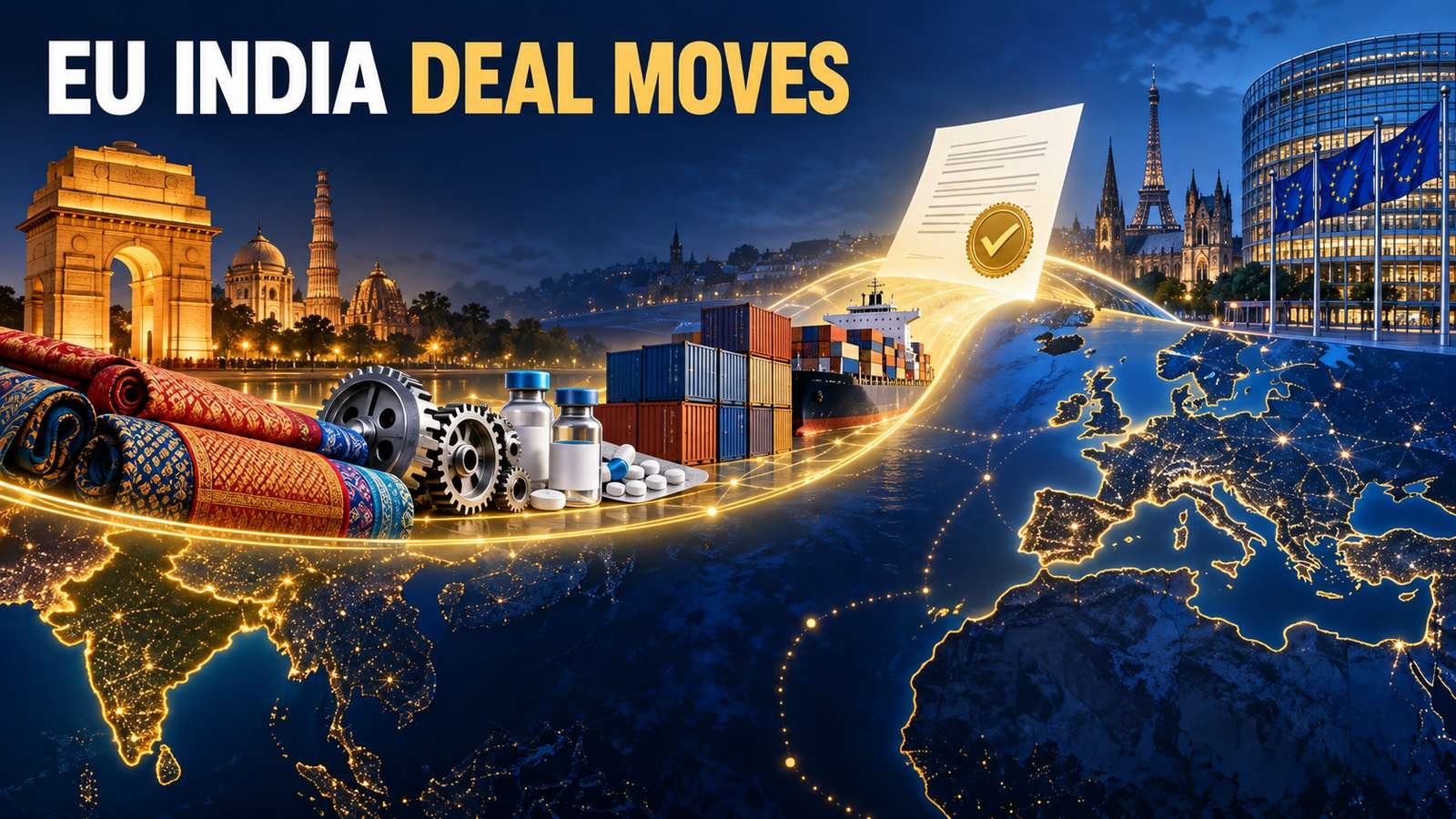
Hero visual created specifically for this article. Thumbnail text: “EU INDIA DEAL MOVES”. It is an editorial illustration, not a market-data screenshot.
Market-risk disclaimer
This article is for market education and information only. It is not investment advice, a recommendation or a promise of returns. Prices, policy decisions, deal terms and forecasts can change; verify the latest primary disclosures and assess risk independently.
- Council approval
- Entry into force
- Preference utilisation
Risk context: This article is for market education and information only. It is not investment advice, a recommendation or a promise of returns. Prices, policy decisions, deal terms and forecasts can change; verify the latest primary disclosures and assess risk independently.
- commission.europa.eu2026-09-13
- policy.trade.ec.europa.eu2026-09-13
- financialexpress.com2026-09-13
- reuters.com2026-01-27
Related PriceVia analysis
India and China Are Talking Again — The $100 Billion Trade Gap Is Still in the Room
Xi Jinping’s first India visit in seven years signals a diplomatic reset, but record bilateral commerce remains shaped by Indian dependence on Chinese machinery, electronics and industrial inputs.
US Inflation Put a Rate Hike Back on the Table — Bonds Are Already There
August CPI accelerated, real wages fell again and markets priced an 87% chance of a quarter-point hike; the near-5% Treasury yield is tightening conditions before the Fed votes.
India Helped Kill Europe’s 15% Scrap Duty — But the Supply Win May Expire
Brussels abandoned a three-year export levy as an India trade deal nears, yet tougher waste rules could still block direct shipments from May 2027.
Peru’s Exports to India Surged 152% — A Trade Deal Is Finally Nearing the Line
India overtook the US as Peru’s second-largest export destination through July, but gold concentration means the headline growth is less diversified than it appears.