Tata Sons Just Lost Its Cleanest Escape From an IPO
RBI has rejected Tata Sons’ request to surrender its core-investment-company registration, keeping India’s largest unlisted holding company on the path toward a potentially historic market debut.
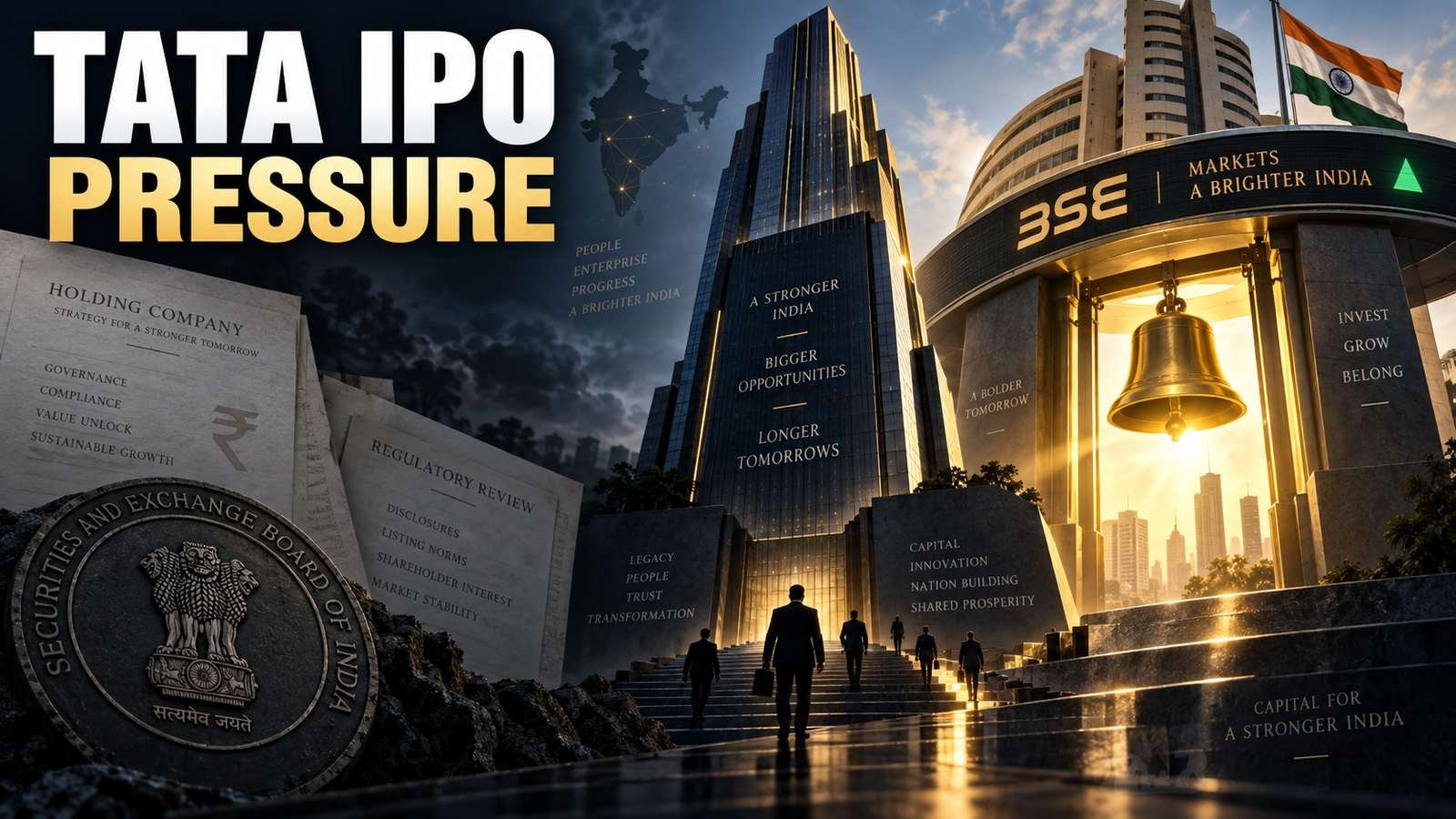
Tata Sons Just Lost Its Cleanest Escape From an IPO
*By PriceVia Markets Desk | Published September 13, 2026 | Updated September 13, 2026*
Why this matters now
RBI has rejected Tata Sons’ request to surrender its core-investment-company registration, keeping India’s largest unlisted holding company on the path toward a potentially historic market debut.
Key points
- RBI rejected Tata Sons’ request to deregister as a core investment company, according to Reuters sources. - A listing requirement is tied to the group holding company’s size and regulatory classification, though timing and route remain unsettled. - The valuation headline matters less than how Tata Trusts, listed Tata companies and minority investors share control and value.
The numbers
| Metric | Value | Context | |---|---:|---| | Standalone assets | ₹1.75tn | March 2025 | | Regulatory threshold | ₹1tn+ | Upper-layer asset trigger | | Tata Trusts stake | 66% | Controlling shareholder | | IPO status | Not yet filed | No draft prospectus | | Status | RBI request rejected | Reported by sources | | Next step | Undisclosed | Listing route and timing |
What happened
Reuters reported that the Reserve Bank of India rejected Tata Sons’ request to surrender its registration as a core investment company. That removes the most direct regulatory route the holding company had sought to avoid a public listing. RBI and Tata Sons had not publicly detailed the decision when the report appeared, so the exact order and any appeal remain to be confirmed. [S1, S2] Tata Sons had standalone assets of about ₹1.75 trillion at March 2025, above the ₹1 trillion size associated with upper-layer non-bank finance-company rules. Tata Trusts owns about 66%, while operating companies and other shareholders own the balance. The governance stakes therefore extend far beyond a normal IPO. [S1, S3]
What everyone is watching
The next signal is procedural: whether Tata Sons changes its balance sheet, seeks another regulatory remedy, or begins formal listing preparation. Banker appointments, board resolutions and a draft prospectus would be stronger evidence than valuation speculation. Investors should also watch listed Tata companies that own Tata Sons shares. Any value unlocked depends on offer structure, lock-ups, liquidity and holding-company discounts; an enormous implied valuation does not automatically translate into equivalent gains for every shareholder.
What the market may be missing
PriceVia analysis: the real event is a forced change in transparency. Public-market reporting could expose capital allocation, cross-holdings and dividend flows at the group centre, giving investors a clearer map of how value moves across the Tata ecosystem. An IPO can also complicate long-term control. Tata Trusts may want to preserve strategic freedom while new public shareholders demand measurable returns, cleaner related-party disclosures and predictable distributions. That tension will shape the eventual valuation.
Positive case
A carefully structured listing improves disclosure, creates a market value for the group centre and gives existing shareholders liquidity without weakening Tata Trusts’ control. Strong demand could establish a new benchmark for Indian holding companies.
Downside case
Legal or restructuring delays stretch for years, the issue is priced at an aggressive premium, or public scrutiny exposes a persistent holding-company discount. Governance friction could outweigh the novelty of a blockbuster IPO.
What would change the story
Watch RBI or Tata Sons confirmation, any appeal, capital restructuring, banker mandates, shareholder approvals and a draft prospectus. Until those appear, “closer to listing” is a regulatory inference rather than a fixed launch calendar.
Verification lens
Confirm which legal entity is subject to the listing timeline and whether asset or debt changes can alter classification. Regulatory status, ownership value and free-float value are three different numbers.
Related stocks and themes
Tata Sons, Tata Trusts, Tata Consultancy Services, Tata Motors, Tata Steel, Indian IPOs, RBI upper-layer NBFC rules and holding-company discounts.
How to read it
Separate regulatory pressure from transaction certainty. Exposure through listed Tata companies should be evaluated on their own cash flows and cross-holding economics, not on a one-line sum-of-the-parts estimate for Tata Sons.
PriceVia View
The RBI decision narrows Tata Sons’ options, but it does not set an IPO date. The investable question is whether a listing converts opaque group value into distributable value—or simply puts a public price on an enduring control discount.
Sources and timestamps
- [S1 — Reuters: RBI rejects Tata Sons deregistration request](https://www.reuters.com/world/india/indias-central-bank-rejects-tata-sons-request-avoid-public-listing-sources-say-2026-09-12/) — published 2026-09-12; accessed 2026-09-13T17:15:00+05:30 - [S2 — RBI: NBFC regulation and disclosures](https://www.rbi.org.in/) — published 2026-09-13; accessed 2026-09-13T17:15:00+05:30 - [S3 — Tata Sons: ownership and group information](https://www.tata.com/about-us/tata-sons) — published 2026-09-13; accessed 2026-09-13T17:15:00+05:30 - [S4 — SEBI: public-issue regulations](https://www.sebi.gov.in/) — published 2026-09-13; accessed 2026-09-13T17:15:00+05:30
Visual disclosure
Hero visual created specifically for this article. Thumbnail text: “TATA IPO PRESSURE”. It is an editorial illustration, not a market-data screenshot.
Market-risk disclaimer
This article is for market education and information only. It is not investment advice, a recommendation or a promise of returns. Prices, policy decisions, deal terms and forecasts can change; verify the latest primary disclosures and assess risk independently.
- Official RBI/Tata statement
- Banker mandate
- Draft prospectus
Risk context: This article is for market education and information only. It is not investment advice, a recommendation or a promise of returns. Prices, policy decisions, deal terms and forecasts can change; verify the latest primary disclosures and assess risk independently.
- reuters.com2026-09-12
- rbi.org.in2026-09-13
- tata.com2026-09-13
- sebi.gov.in2026-09-13
Related PriceVia analysis

Tesla Set October 1 for the Roadster — Nine Years of Delay Make the Date the Product
The sports car first shown in 2017 is set for another reveal, potentially with SpaceX-linked technology, but delivery evidence will matter more than spectacle.

Revolut Trusted a Government Email — Attackers Turned It Into a Data Breach
Fraudulent requests sent from a legitimate agency email domain exposed sensitive customer identity data, revealing a social-engineering weakness outside the bank’s core systems.

A Pipeline Carrying Up to 5% of Global Oil Supply Was Shut
The 1,200-kilometre route that bypasses Hormuz has been taken offline after an attack linked to infrastructure from Iraq, tightening an already fragile Red Sea shipping system.

South Korea’s New Espionage Law Now Covers Every Foreign State
The law taking effect September 13 broadens prosecution beyond North Korea and sets a minimum three-year prison term, raising compliance stakes across chips, batteries, displays and AI.