Nepal May Need Up to $5 Billion to Rebuild — The 12% Hydropower Hit Makes This an Energy Shock Too
The reconstruction bill could approach a tenth of Nepal’s economy, while damage to power projects adds an energy and fiscal layer to the humanitarian disaster.
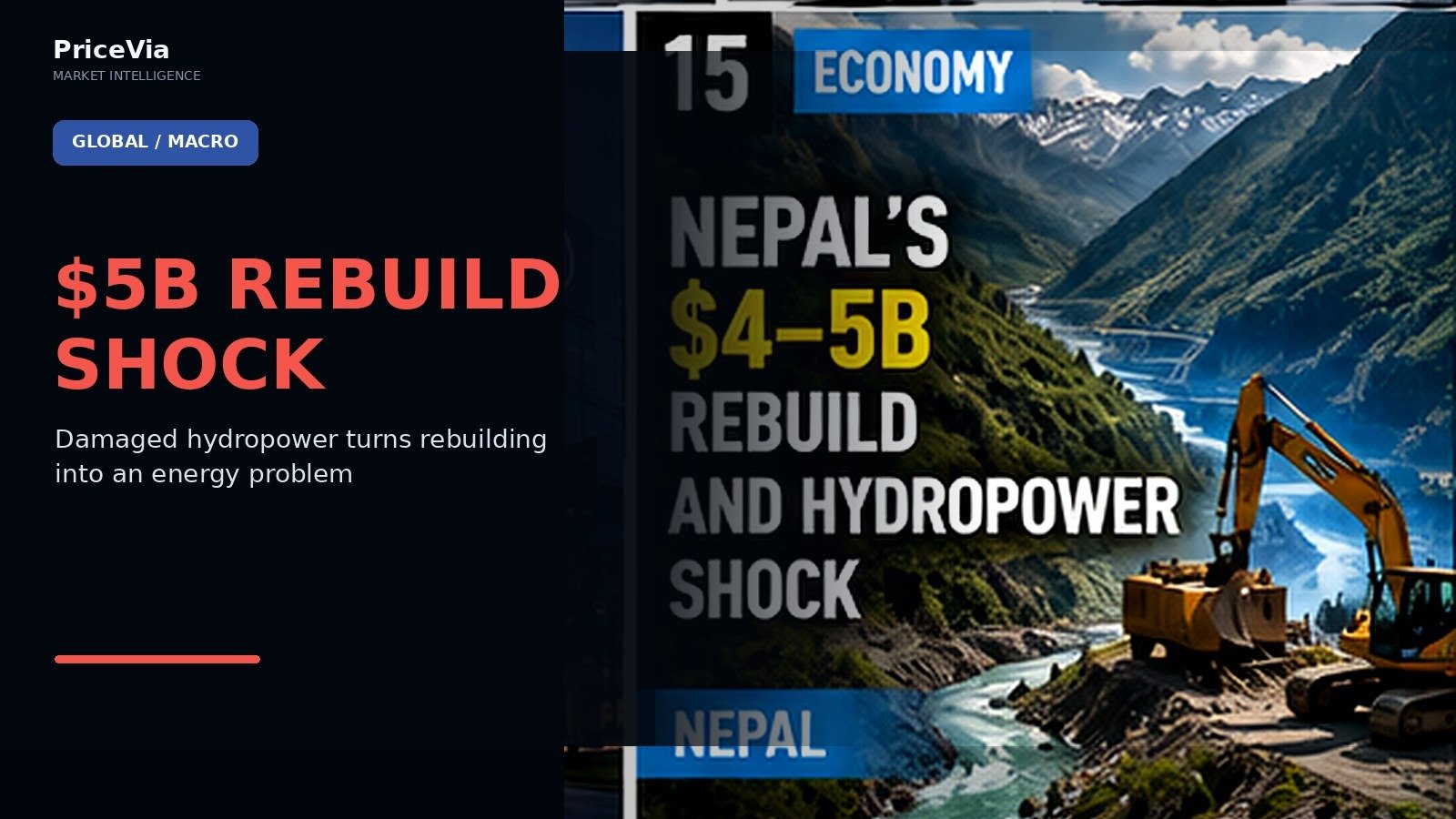
Nepal’s finance minister estimates the country may need $4 billion to $5 billion to rebuild after catastrophic flooding triggered by a glacier collapse. The figure is close to a tenth of the economy, making the disaster not only a humanitarian emergency but also a major fiscal and infrastructure shock.
The energy dimension is especially important. Reuters reported that damaged power projects represent more than 12% of Nepal’s national generating capacity, raising the possibility that reconstruction spending must compete with the urgent need to restore electricity supply.
WHAT HAPPENED
The floods destroyed towns, roads, bridges and hydropower infrastructure across affected Himalayan regions. Finance Minister Swarnim Wagle said the early reconstruction estimate could reach $4 billion to $5 billion, while full damage assessments are still underway.
The event comes in an economy heavily dependent on remittances, tourism and hydropower, making infrastructure restoration central to both household welfare and macroeconomic recovery.
WHAT EVERYONE IS WATCHING
The immediate priority is rescue and humanitarian relief.
From a market and policy perspective, the next questions are financing and sequencing: how much comes from domestic borrowing, multilateral institutions, grants or bilateral partners, and which infrastructure is restored first.
WHAT THE MARKET MAY BE MISSING
Hydropower damage creates a second-order economic effect.
If power shortages persist, businesses face higher operating costs at the same time public finances are under reconstruction pressure. The government may also lose export or utility revenue while spending heavily on rebuilding.
That means the fiscal cost can exceed the direct cost of bridges and plants because weaker activity and lower revenue can arrive at the same time.
THE NUMBERS
• Preliminary rebuilding estimate: $4 billion–$5 billion • Scale: close to 10% of Nepal’s economy • Hydropower capacity affected in Reuters estimate: more than 12% of national generating capacity • Full loss-and-damage assessment: still underway • Core financing challenge: reconstruction without destabilising public finances
POSITIVE CASE
Multilateral grants and concessional financing arrive quickly, hydropower is restored in stages and reconstruction raises longer-term infrastructure resilience rather than only replacing damaged assets.
DOWNSIDE CASE
Costs rise beyond initial estimates, energy disruptions persist and reconstruction requires expensive borrowing. Tourism and private investment could also weaken during the recovery period.
WHAT WOULD CHANGE THE STORY
A formal government damage assessment, multilateral funding packages, hydropower restoration timelines and updated fiscal projections will determine the macroeconomic impact.
RELATED THEMES
Nepal, hydropower, Himalayan infrastructure, climate risk, sovereign financing, reconstruction and South Asian energy.
PRICEVIA VIEW
The tragedy is first and foremost human. The financial angle is that damaged power capacity can turn a large reconstruction bill into a broader growth and fiscal shock unless energy infrastructure is restored quickly.
SOURCES & TIMESTAMP
Reuters August 29 reconstruction report and contemporaneous regional business coverage, accessed August 30 IST. Human-casualty figures were intentionally not used as a promotional hook.
MARKET-RISK DISCLAIMER
For information and education only; not investment advice. Markets, regulatory outcomes, transaction terms and company guidance can change. Time-sensitive facts should be rechecked before acting.
Related PriceVia analysis

Trump Removed Irish Whiskey’s 10% Tariff — Now the Paperwork Must Catch Up
The announcement offers relief to distillers after duties on EU wine and spirits, but exporters still need a formal implementation path and want zero-for-zero treatment across the drinks trade.

India Is Importing Sugar Again — Festival Prices Forced the Door Open
New Delhi allowed one million tonnes of duty-free imports and warned mills to keep supplies adequate after hoarding pushed prices to a record and 20% above levels two months earlier.

India and China Are Talking Again — The $100 Billion Trade Gap Is Still in the Room
Xi Jinping’s first India visit in seven years signals a diplomatic reset, but record bilateral commerce remains shaped by Indian dependence on Chinese machinery, electronics and industrial inputs.

The India–EU Trade Deal Cleared Another Gate — Ratification Is the Real Finish Line
The European Commission has advanced the agreement toward Council approval and signature, but tariff savings and 2027 implementation still depend on legal completion and ratification.