J&J’s Orthopedics Unit Could Fetch $20 Billion — The Separation Math Is Tight
Apollo is reportedly among bidders for DePuy Synthes, a $9.3 billion-revenue business; the buyer must find growth and margin upside in a mature, regulated implant market.
J&J’s Orthopedics Unit Could Fetch $20 Billion — The Separation Math Is Tight
**Apollo is reportedly among bidders for DePuy Synthes, a $9.3 billion-revenue business; the buyer must find growth and margin upside in a mature, regulated implant market.**
*By PriceVia Deals Desk | Published September 11, 2026 | Updated September 11, 2026*
Why this matters now
Apollo is reportedly among bidders for DePuy Synthes, a $9.3 billion-revenue business; the buyer must find growth and margin upside in a mature, regulated implant market.
Key points
- Apollo is reported to be in talks to acquire J&J’s orthopedics business at close to a $20 billion valuation. - DePuy Synthes generated $9.3 billion in 2025 sales and makes hip, knee and shoulder implants. - The overlooked question is whether a private-equity deal can improve returns without underinvesting in product quality, sales coverage or innovation.
The numbers
| Metric | Value | Context | |---|---:|---| | Possible valuation | ~$20bn | Reported talks | | 2025 sales | $9.3bn | Orthopedics unit | | Planned separation | 18–24 months | J&J’s prior timeline | | Buyer interest | Several PE firms | Reported | | Major joints | 3 | Hip, knee, shoulder | | Possible agreement | Within weeks | Bloomberg report |
What happened
Apollo Global is in talks to buy Johnson & Johnson’s orthopedics unit in a transaction that could value the business near $20 billion, Bloomberg reported and Reuters relayed. Several private-equity firms are interested, and an agreement could emerge within weeks; Reuters had not independently verified the report. [S1, S2] J&J previously planned to separate DePuy Synthes into a standalone company within 18 to 24 months. The operation generated $9.3 billion of sales in 2025 from implants, surgical tools and related products. [S1, S3]
What everyone is watching
The transaction structure will be decisive. A full sale, carve-out financing or minority solution creates different tax, debt and transition-service needs. Separation costs can absorb part of the headline value. Hospitals and surgeons care about product reliability, training and supply continuity. Any ownership transition must preserve regulatory systems and clinical support; cost cutting that disrupts those capabilities can damage revenue more than it saves.
What the market may be missing
PriceVia analysis: the reported value equals a little over two times 2025 sales, which looks moderate beside high-growth medtech but may reflect slower orthopedics growth and carve-out complexity. Profit, cash conversion and reinvestment needs are not disclosed in the report. Private equity could create value through focused management and operational improvement. It could also use substantial leverage, making the business more sensitive to procedure volumes, reimbursement and product liability.
Positive case
A buyer installs dedicated leadership, accelerates innovation and improves manufacturing while preserving clinical quality. J&J releases capital for faster-growing medicines and devices, and the standalone unit gains strategic focus.
Downside case
Financing becomes expensive, separation costs rise or product and regulatory issues disrupt sales. Heavy leverage limits research, inventory and surgeon-support investment in a competitive market.
What would change the story
Watch confirmation from J&J or Apollo, valuation, financing, liabilities retained, regulatory approvals and transition agreements. Disclosure of EBITDA and capital needs would determine whether the reported price is attractive.
Related stocks and themes
Johnson & Johnson, Apollo Global, DePuy Synthes, Stryker, Zimmer Biomet, medical devices, private equity and healthcare carve-outs.
How to read it
Until companies confirm terms, price the report as a possibility. If a deal appears, focus on liabilities, transition services and leverage rather than sales multiple alone. Those details decide which side captures the separation value.
PriceVia View
The $20 billion headline is easy; the carve-out is the work. Orthopedics depends on quality systems and surgeon relationships that cannot be treated like disposable overhead.
Sources and timestamps
- [S1 — Reuters: Apollo-J&J talks report](https://www.reuters.com/business/healthcare-pharmaceuticals/apollo-global-talks-acquire-jjs-orthopedics-unit-bloomberg-news-reports-2026-09-11/) — published 2026-09-11; accessed 2026-09-11T23:20:00+05:30 - [S2 — Bloomberg: original deal report](https://www.bloomberg.com/) — published 2026-09-11; accessed 2026-09-11T23:20:00+05:30 - [S3 — Johnson & Johnson: investor relations](https://www.investor.jnj.com/) — published 2026-09-11; accessed 2026-09-11T23:20:00+05:30 - [S4 — Apollo Global: investor relations](https://ir.apollo.com/) — published 2026-09-11; accessed 2026-09-11T23:20:00+05:30
Visual disclosure
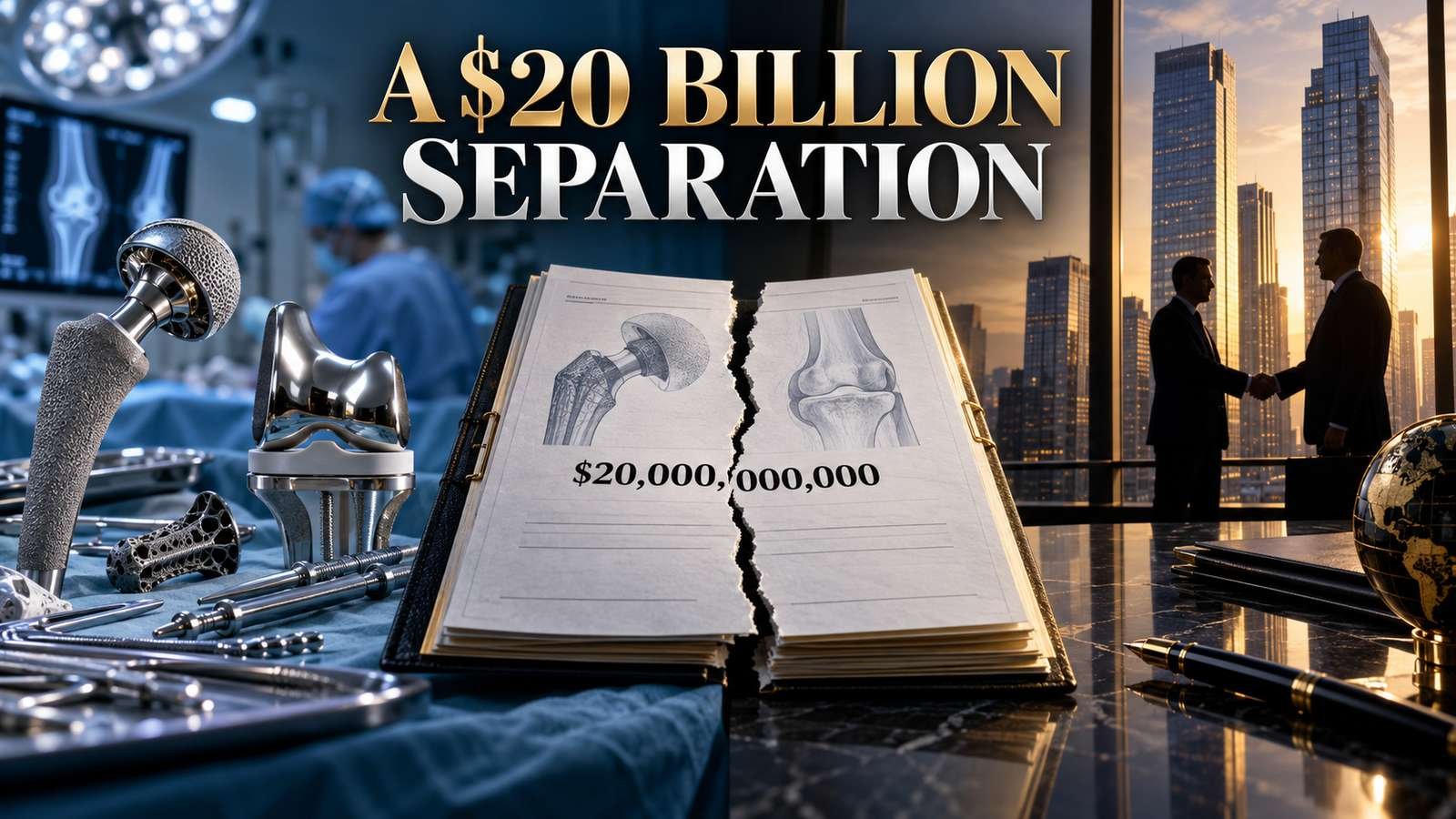
Hero visual created specifically for this article. Thumbnail text: “A $20 BILLION SEPARATION”. It is an editorial illustration, not a market-data screenshot.
Market-risk disclaimer
This article is for market education and information only. It is not investment advice, a recommendation or a promise of returns. Prices, policy decisions, deal terms and forecasts can change; verify the latest primary disclosures and assess risk independently.
- Confirmed terms
- Carve-out liabilities
- Financing structure
Risk context: This article is for market education and information only. It is not investment advice, a recommendation or a promise of returns. Prices, policy decisions, deal terms and forecasts can change; verify the latest primary disclosures and assess risk independently.
- reuters.com2026-09-11
- bloomberg.com2026-09-11
- investor.jnj.com2026-09-11
- ir.apollo.com2026-09-11
Related PriceVia analysis

Tesla Set October 1 for the Roadster — Nine Years of Delay Make the Date the Product
The sports car first shown in 2017 is set for another reveal, potentially with SpaceX-linked technology, but delivery evidence will matter more than spectacle.

Revolut Trusted a Government Email — Attackers Turned It Into a Data Breach
Fraudulent requests sent from a legitimate agency email domain exposed sensitive customer identity data, revealing a social-engineering weakness outside the bank’s core systems.

A Pipeline Carrying Up to 5% of Global Oil Supply Was Shut
The 1,200-kilometre route that bypasses Hormuz has been taken offline after an attack linked to infrastructure from Iraq, tightening an already fragile Red Sea shipping system.

South Korea’s New Espionage Law Now Covers Every Foreign State
The law taking effect September 13 broadens prosecution beyond North Korea and sets a minimum three-year prison term, raising compliance stakes across chips, batteries, displays and AI.