Tesla Fell Nearly 6% After Cybercab’s First Day — The Missing Steering Wheel Is Now a Regulatory Question
NHTSA opened an audit of Tesla’s self-certification immediately after limited Austin deployment, focusing on how a car without a steering wheel, pedals or mirrors complies with existing safety standards.
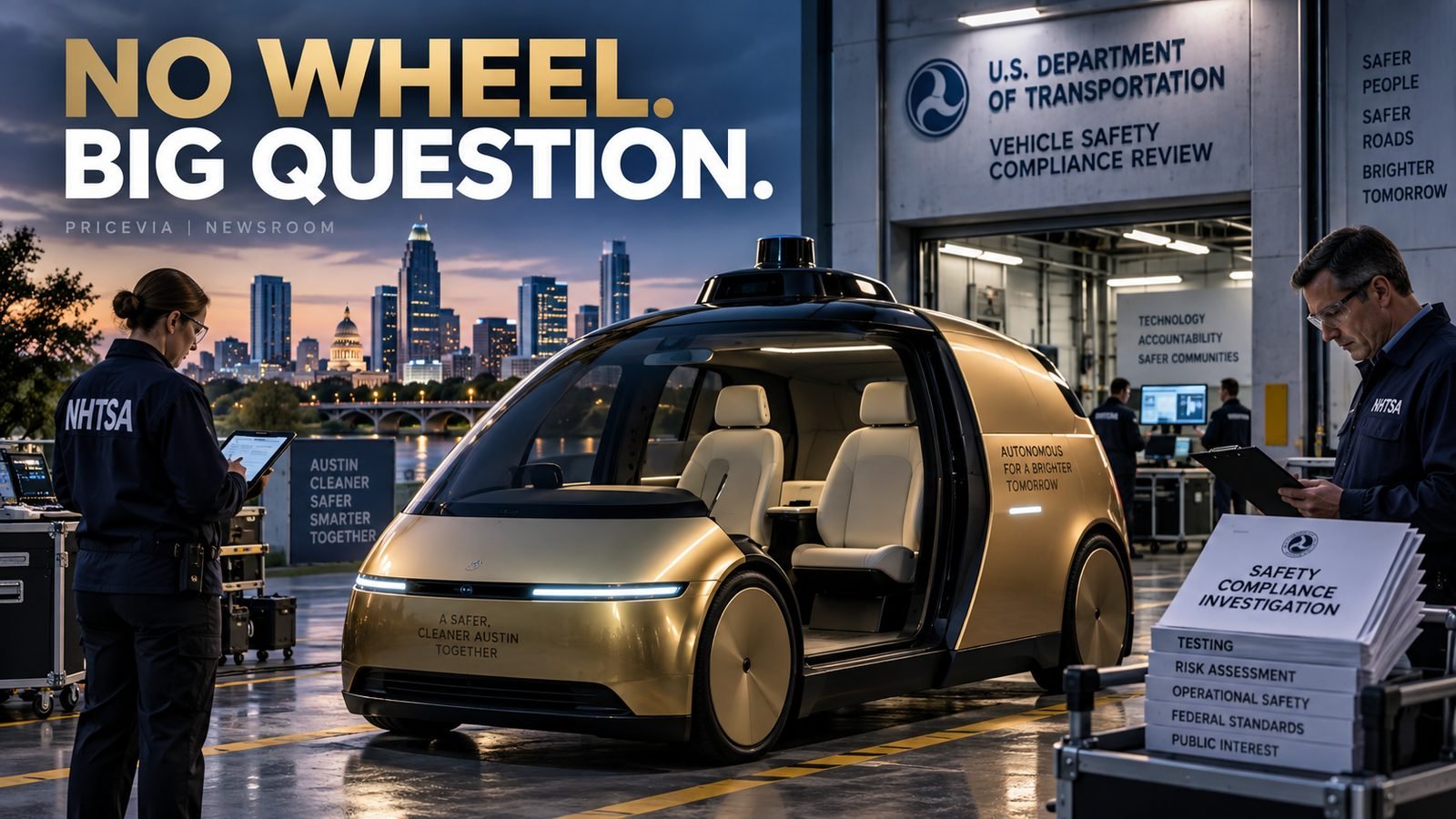
NHTSA opened an audit of Tesla’s self-certification immediately after limited Austin deployment, focusing on how a car without a steering wheel, pedals or mirrors complies with existing safety standards.
Key points
- NHTSA opened an investigation into Tesla’s self-certification of up to 1,000 Cybercabs after limited commercial deployment. - The two-seat vehicle has no steering wheel, brake pedal or conventional mirrors, while current federal standards still contain human-control requirements. - Tesla did not seek an exemption; the central question is which standards it judged inapplicable and why.
The numbers
| Metric | Value | Context | |---|---:|---| | Vehicles in audit scope | Up to 1,000 | Self-certified Cybercabs | | Reported Texas Cybercabs | 45 | Registered by early September | | Seating capacity | 2 | Purpose-built robotaxi | | Steering wheel / pedals | None | Core compliance question | | Tesla share move | Nearly -6% | Friday after probe news | | Probe date | Sep 4, 2026 | One day after rollout announcement |
What happened
The US National Highway Traffic Safety Administration opened an investigation into whether Tesla properly self-certified its Cybercab robotaxis under federal motor-vehicle safety standards. The audit covers up to 1,000 vehicles and followed the start of limited customer rides in Austin. [S1, S2] Cybercab is designed without a conventional steering wheel, brake pedal or mirrors. Tesla did not apply for an exemption; instead, it certified that the vehicle complies with applicable rules. NHTSA wants the technical and legal basis for treating some human-control requirements as inapplicable. Tesla shares fell nearly 6% on Friday. [S1, S2, S3]
What everyone is watching
The first question is whether the regulator requests changes, limits deployment or accepts Tesla's interpretation. An audit is not a finding of wrongdoing, and it does not by itself prove the Cybercab is unsafe. It means the certification logic must withstand detailed review. Investors also need to separate fleet scale from the narrative. Reuters reported 45 Cybercabs registered in Texas by early September. That is enough to begin commercial learning but far from a national network, so regulatory timing can still shape manufacturing, city expansion and unit economics. [S2]
The PriceVia angle
PriceVia analysis: removing human controls is not merely a design choice—it changes the regulatory pathway. A modified Model Y can retain conventional compliance assumptions; a purpose-built driverless car forces agencies to decide how standards written for humans apply when no human can take over. The overlooked valuation variable is deployment permission per vehicle, not miles driven in a demonstration. Robotaxi economics improve with fleet utilisation and low supervision costs, but those benefits only scale if federal and state rules permit a repeatable rollout. Regulatory friction can delay revenue even when the software appears ready.
Positive scenario
Tesla supplies a defensible certification record, the audit closes without material restrictions and Austin data support broader approvals. Purpose-built vehicles then reduce operating cost and improve utilisation as the network expands.
Risk scenario
NHTSA determines that exemptions or redesigns are required, slowing production and city launches. Additional probes into autonomous-driving performance could compound compliance costs and weaken confidence in the rollout timetable.
What would change the story
Watch NHTSA document requests, Tesla's formal response, any stop-sale or recall action, exemption filings, Austin fleet size, intervention and incident data, and expansion permissions. A published compliance rationale accepted by NHTSA would remove the largest immediate uncertainty.
Related stocks and themes
Tesla, Alphabet's Waymo, autonomous vehicles, robotaxis, auto safety regulation, lidar and sensor suppliers, ride-hailing platforms and mobility insurance.
Sources and timestamps
- [S1 — NHTSA: investigation into Tesla Cybercab self-certification](https://www.nhtsa.gov/press-releases/investigation-tesla-cybercab-self-certification) — published 2026-09-04; accessed 2026-09-06T13:20:00+05:30 - [S2 — Reuters: probe scope, vehicle design and Texas registrations](https://www.reuters.com/business/autos-transportation/us-auto-safety-regulator-opens-probe-into-nearly-1000-tesla-cybercabs-2026-09-04/) — published 2026-09-04; accessed 2026-09-06T13:20:00+05:30 - [S3 — AP: investigation follows steering-wheel-free taxi rollout](https://apnews.com/article/2228b6499d46c79169672f874e67eef1) — published 2026-09-04; accessed 2026-09-06T13:20:00+05:30 - [S4 — Wall Street Journal: NHTSA Cybercab compliance review](https://www.wsj.com/business/autos/nhtsa-opens-probe-into-teslas-cybercab-rollout-06aa6eac) — published 2026-09-04; accessed 2026-09-06T13:20:00+05:30
Visual disclosure
Hero visual created specifically for this article. Thumbnail text: “NO WHEEL. BIG QUESTION.”. It is an editorial illustration, not a market-data screenshot.
Market-risk disclaimer
This article is for market education and information only. It is not investment advice, a recommendation, or a promise of returns. Market prices, flows, transaction terms, approvals and company plans can change; verify the latest primary disclosures and assess risk independently.
- NHTSA findings
- Austin fleet and incident data
- Exemption or redesign requirements
Risk context: This article is for market education and information only. It is not investment advice, a recommendation, or a promise of returns. Market prices, flows, transaction terms, approvals and company plans can change; verify the latest primary disclosures and assess risk independently.
- nhtsa.gov2026-09-04
- reuters.com2026-09-04
- apnews.com2026-09-04
- wsj.com2026-09-04
Related PriceVia analysis

Z.AI Raised $5 Billion — The Bond Can Turn Into Stock Within a Year
The Chinese AI developer combined a $2 billion equity placement with $3 billion of zero-coupon convertibles due in September 2027, funding compute while creating dilution and refinancing questions.

Canada Changed Its Index Gate — A $53 Billion Copper Merger May Walk Through
Foreign issuers with a material Canadian connection can qualify from December 21, potentially keeping Anglo-Teck inside the benchmark despite a London primary listing.
Trump Opened the Door to Chinese Car Factories — US Law Still Keeps It Shut
The president says plants that hire Americans could be acceptable, but an effective ban, tariffs above 100% and opposition from automakers and lawmakers make the path legally and politically uncertain.

Amazon Paused a Cargo Partner After Five Deaths — Logistics Speed Meets Safety Risk
The retailer suspended work with 21 Air after a 32-year-old Boeing 767 freighter overran a runway, while investigators examine speed and a considered go-around.