India Blocked Alipay+ From UPI — Data Beat Convenience
The proposed cross-border connection promised access to more than 150 million Asian merchants, but questions around Chinese ownership, data storage, cyberfraud and money laundering stopped the plan.
India Blocked Alipay+ From UPI — Data Beat Convenience
*By PriceVia Policy Desk | Published September 14, 2026 | Updated September 14, 2026*
Why this matters now
The proposed cross-border connection promised access to more than 150 million Asian merchants, but questions around Chinese ownership, data storage, cyberfraud and money laundering stopped the plan.
Key points
- India has stalled Alipay+’s January proposal to connect with UPI for cross-border payments. - The first phase would have helped Indian travellers pay across an Alipay+ merchant network exceeding 150 million locations. - Security and data-control concerns overrode the commercial case, with no defined route forward.
The numbers
| Metric | Value | Context | |---|---:|---| | Proposal month | January 2026 | Submitted plan | | Merchant network | 150m+ | Alipay+ footprint | | Planned phases | 2 | Outbound then inbound | | UPI August volume | 24.51bn | Transactions | | 2024 APAC outbound market | $12tn+ | Underlying market context | | 2032 projection | $23.8tn | Third-party cross-border estimate |
What happened
Reuters reported that Indian authorities stalled a proposal by Ant International’s Alipay+ to link with UPI. Concerns included national security, customer-data storage and use, cyberfraud and money laundering. The finance, home and external-affairs ministries, RBI, NPCI and Ant International did not comment to Reuters. [S1, S2] The proposed two-stage connection would first let Indian travellers use UPI across the Alipay+ network and later allow international users to transact through Alipay+ in India. The network covers more than 150 million merchants across China, Hong Kong and other Asian markets. [S1, S3]
What everyone is watching
Any revised plan must explain data location, controller responsibility, law-enforcement access, dispute resolution and technical isolation. A commercial partnership cannot solve a sovereign-data concern with ordinary contract language. Travellers and merchants will watch whether UPI builds bilateral links directly with additional countries instead. Direct connections may be slower to negotiate but easier for regulators to govern.
What the market may be missing
PriceVia analysis: this is a test of whether payment interoperability can be separated from platform trust. A technically open rail still depends on who sees transaction metadata, authenticates users and resolves fraud. The block also limits network effects. Every rejected connection reduces UPI’s international reach, giving card networks and alternative wallets more time to defend cross-border payments.
Positive case
A redesigned architecture limits data exposure, creates reciprocal oversight and receives approval. Indian travellers gain lower-cost payments without weakening domestic control of sensitive data.
Downside case
The proposal remains frozen, regional merchants prioritise competing wallets and bilateral alternatives take years. Political tension could spread to other fintech partnerships beyond Alipay+.
What would change the story
Watch formal statements from RBI or NPCI, localisation commitments, a new technical design and bilateral payment agreements. A pilot with published safeguards would materially change the thesis.
Related stocks and themes
UPI, Alipay+, Ant International, NPCI, RBI, cross-border payments, data localisation, cyberfraud and India–China finance.
How to read it
Payment-company investors should treat regulatory trust as infrastructure. Merchant reach is valuable only when authorities accept the ownership, data and enforcement model behind it.
Verification discipline
The confirmed facts above come from the cited reporting and primary sources. Readers should re-check regulatory statement, because that is the clearest next test of whether the present interpretation still holds. Reported plans, proposals and forecasts are labelled as such; they are not treated as completed outcomes.
PriceVia View
The lost convenience is visible; the avoided risk is harder to measure. India is signalling that UPI’s international growth will not come at the price of uncertain control over payment data.
Sources and timestamps
- [S1 — Reuters: India stalls Alipay+ UPI link](https://www.reuters.com/world/china/india-stalls-alipay-payments-link-over-security-data-concerns-sources-say-2026-09-03/) — published 2026-09-03; accessed 2026-09-14T09:45:00+05:30 - [S2 — NPCI: UPI global information](https://www.npci.org.in/what-we-do/upi-global/upi-global) — published 2026-09-14; accessed 2026-09-14T09:45:00+05:30 - [S3 — Alipay+: company information](https://www.alipayplus.com/) — published 2026-09-14; accessed 2026-09-14T09:45:00+05:30 - [S4 — RBI: payment data localisation circulars](https://www.rbi.org.in/) — published 2026-09-14; accessed 2026-09-14T09:45:00+05:30
Visual disclosure
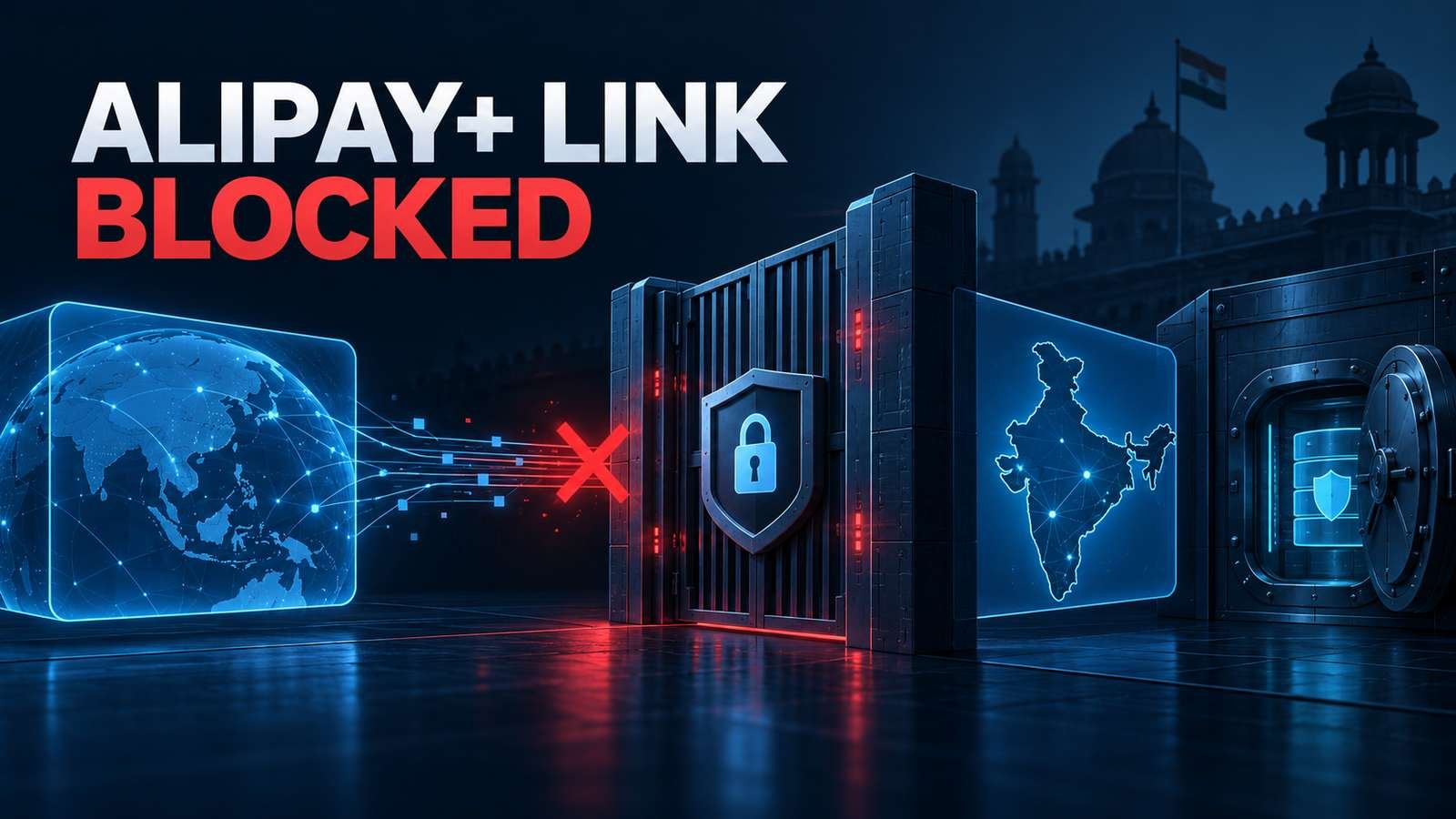
Hero visual created specifically for this article. Thumbnail text: “ALIPAY+ LINK BLOCKED”. It is an editorial illustration, not a market-data screenshot.
Market-risk disclaimer
This article is for market education and information only. It is not investment advice, a recommendation or a promise of returns. Prices, policy decisions, deal terms and forecasts can change; verify the latest primary disclosures and assess risk independently.
- Regulatory statement
- Revised architecture
- New bilateral links
Risk context: This article is for market education and information only. It is not investment advice, a recommendation or a promise of returns. Prices, policy decisions, deal terms and forecasts can change; verify the latest primary disclosures and assess risk independently.
- reuters.com2026-09-03
- npci.org.in2026-09-14
- alipayplus.com2026-09-14
- rbi.org.in2026-09-14
Related PriceVia analysis

Z.AI Raised $5 Billion — The Bond Can Turn Into Stock Within a Year
The Chinese AI developer combined a $2 billion equity placement with $3 billion of zero-coupon convertibles due in September 2027, funding compute while creating dilution and refinancing questions.

Canada Changed Its Index Gate — A $53 Billion Copper Merger May Walk Through
Foreign issuers with a material Canadian connection can qualify from December 21, potentially keeping Anglo-Teck inside the benchmark despite a London primary listing.
Trump Opened the Door to Chinese Car Factories — US Law Still Keeps It Shut
The president says plants that hire Americans could be acceptable, but an effective ban, tariffs above 100% and opposition from automakers and lawmakers make the path legally and politically uncertain.

Amazon Paused a Cargo Partner After Five Deaths — Logistics Speed Meets Safety Risk
The retailer suspended work with 21 Air after a 32-year-old Boeing 767 freighter overran a runway, while investigators examine speed and a considered go-around.