The BIS Says Stablecoins Still Fail the ‘Money’ Test — Tokenised Bank Deposits May Be the Bigger Threat
The world’s central-bank forum is not rejecting tokenisation; it is arguing that bank deposits, not stablecoins, should carry most everyday and wholesale payment activity.
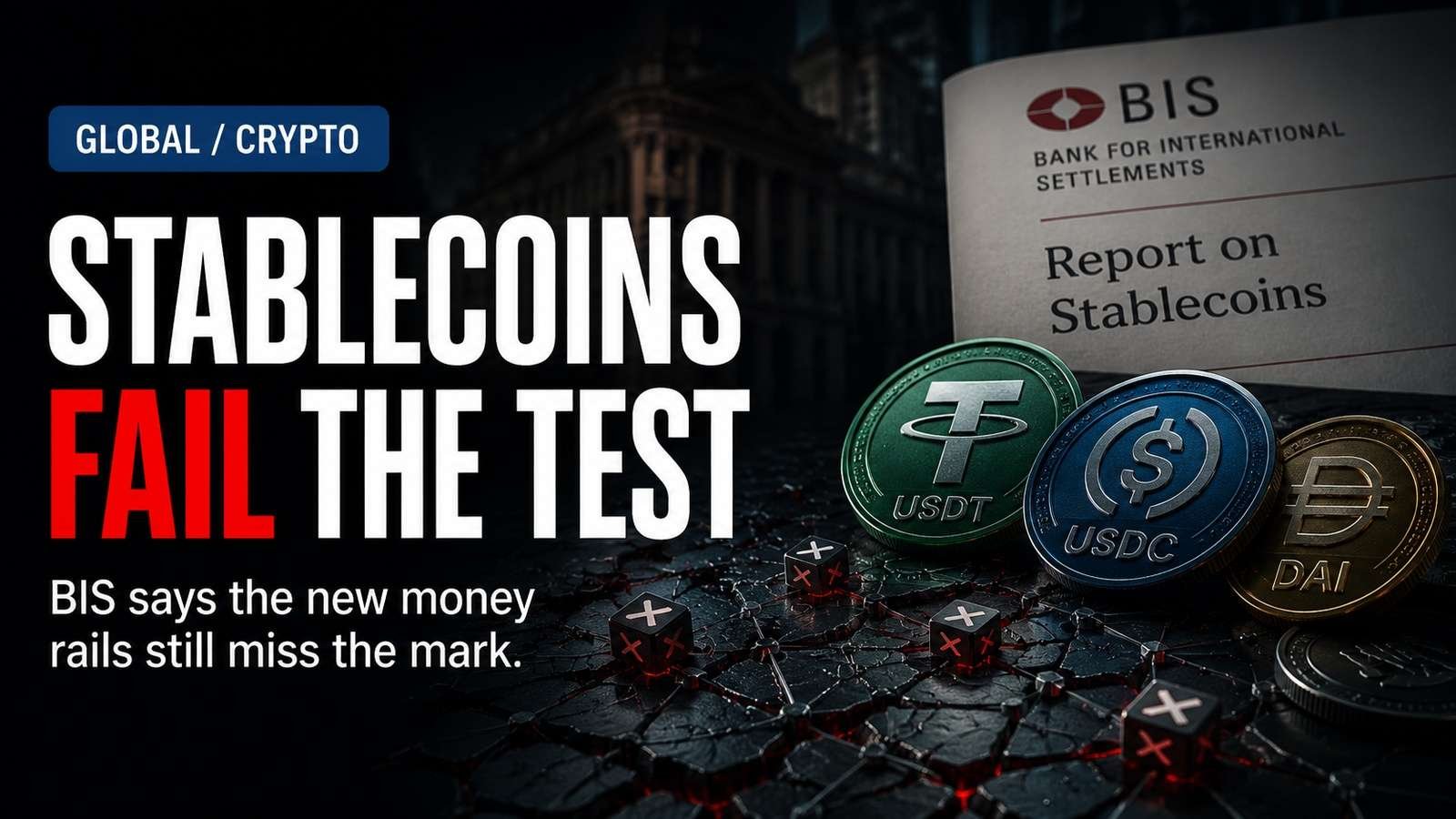
The Bank for International Settlements has sharpened a debate that matters far beyond crypto prices. BIS General Manager Pablo Hernández de Cos says stablecoins, in their current form, do not credibly function as money at scale and argues that tokenised bank deposits offer a stronger foundation for mainstream payments.
The important part is what the BIS is not saying. It is not rejecting tokenisation. It is trying to keep tokenisation inside a two-tier monetary system anchored by central-bank money.
WHAT HAPPENED
At Jackson Hole, de Cos compared stablecoins with tokenised deposits across three properties: singleness of money, interoperability and financial integrity.
He highlighted risks from price deviations, fragmented blockchains, self-custodied wallets, AML/CFT challenges and potential shifts in bank funding. Tokenised deposits, by contrast, remain supervised bank liabilities and can settle through central-bank money.
WHAT EVERYONE IS WATCHING
Crypto investors will focus on whether regulation becomes more hostile to stablecoins.
Banks should focus on the competitive opening. If tokenised deposits gain programmable settlement, 24/7 operation and interoperability, they can copy several useful features of stablecoins without forcing customers outside the banking system.
WHAT THE MARKET MAY BE MISSING
The biggest stablecoin risk may not be prohibition. It may be successful imitation by regulated deposits.
If banks can offer instant programmable money with final settlement and deposit relationships intact, stablecoins may remain important in crypto-native and cross-border niches while losing the argument for becoming the default form of digital cash.
THE NUMBERS
• BIS position: stablecoins do not yet meet the requirements of money at scale • Preferred core: tokenised deposits anchored in central-bank settlement • Main concerns: singleness, interoperability, integrity and bank-funding effects • BIS allows that stablecoins may retain specialised roles • Project Agorá is cited as evidence of institutional tokenisation experimentation
POSITIVE CASE
Clear stablecoin rules and better interoperability could close some gaps while preserving innovation. Dollar stablecoins may remain powerful where domestic payment systems are weak or cross-border demand is high.
DOWNSIDE CASE
Aggressive bank-led tokenisation could compress stablecoin growth in regulated payments. Conversely, restrictions that are too heavy could push activity toward less transparent offshore rails.
WHAT WOULD CHANGE THE STORY
Stablecoin legislation, central-bank access rules, tokenised-deposit pilots, Project Agorá results and real adoption by banks will decide which model captures payment volume.
RELATED THEMES
USDT, USDC, stablecoin issuers, banks, tokenised deposits, BIS, central-bank money, Project Agorá and digital-dollar competition.
PRICEVIA VIEW
The debate is no longer “blockchain versus banks.” The BIS is effectively proposing “blockchain through banks.” That is a very different competitive map.
SOURCES & TIMESTAMP
BIS official Jackson Hole speech and Reuters report published August 28, accessed August 29, 2026 IST.
MARKET-RISK DISCLAIMER
For information and education only; not investment advice. Markets, regulatory decisions and transaction terms can change, and investors should verify time-sensitive information before acting.
Related PriceVia analysis

Bitcoin Suisse May Cut Half Its Swiss Staff — The Crypto Hub Is Moving
The Zug-based firm will consolidate software and back-office work internationally, close Copenhagen development and build a Vietnam hub—showing cost geography matters even in premium crypto finance.

Bitcoin ETFs Pulled In $731 Million — Then One Jobs Report Tested the Conviction
US spot Bitcoin funds posted their best daily inflow since January, led by BlackRock’s IBIT, before strong payrolls revived Fed-hike expectations and cooled Friday’s risk appetite.

Standard Chartered Put Bitcoin Trading Inside a Global Bank — The UAE Is the Test Market
Eligible institutions can now trade deliverable spot Bitcoin and Ether through bank-style electronic channels, joining execution with custody while leaving retail and token breadth outside the launch.

London Wants Tokenised Shares Without Sacrificing Shareholder Rights — That Is the Real Market-Structure Test
LSEG and Payward are connecting regulated equities with blockchain distribution, but a token backed by a share is not automatically the same legal object as the share itself.